Tuesday, 31 March 2009

Religion in Japan


The focus for this weeks post is about religion in Japan. I won't go into deep about religion in Japan because I don't consider myself as a ethnographic authority enough. Instead of trying to explain how the religion works in Japan and so on, I will tell how the impression I got from how religious people are here. Even though I have spend more than half my semester here in Japan already, I still keep getting surprised how religion is part of the daily life in Japan.

The first picture I have chosen is of a shrine just outside of Kansai Gaidai University. The first time I saw this shrine I was quite surprised because it was on a crowded street. Soon I realised during my stay here in Japan that religion is part of the daily life. It's hard to talk a walk without seeing something connected to religion. I think this shrine shows how big religion is in Japan. Even though Japan is one of the busiest and crowdiest countries in the world, people still take time to pay their respect to a shrine, even in the most unexpected places.


My second picture is taken in Uji, just outside of Kyoto. This is a picture of the famous temple, Byôdô-in which is famous for its big golden Buddhastatue and its two golden phoenixes on its rooftop. This is also the picture of the back of the 10 yen coin. When we enter temple to see the big golden Buddha (pictures were not allowed) The guide told us about the story of why the Buddha was placed right there and explaned why there were a lot of other small Bodhisattvas on clouds. After the guide was over, people stayed a little bit after and clapped their hands twice and then closed their eyes while they were bowing.


So what kind of impression do I have of religion in Japan? If I make comparison between Sweden and Japan, the difference are a lot more. In Sweden we do have a lot less religion in public, even though you can easily spot churches everywhere. But it's not as part of your daily life if your not a religious person. In Japan, religion is part of the culture, and you can see buddhas in stores, shrines everywhere and it's not uncommon to see ads where you can see temples.

So to make a short summary, do these two examples explain the religion in Japan? These examples might be a small part of Japanese culture, I am saying culture because the impression I got from Japan is that their lives are not affected by religion so much, but instead of how religion have affected the culture. Things are implied in the culture today, and even if they aren't religious that still don't necessarily means that they don't have faith. On every temple I have been too there are always different things you can do that are said to give you good luck or viceversa. Even though I got the impression I have from Japanese people being very busy and stressed, they still take their time to go to a shrine and pray. Perhaps to get strength to continue their day.

Tuesday, 24 March 2009

The Japanese Version

The theme I have chosen for this weekend is about the Japanese music culture and how different Japanese bands use English in their lyrics. A lot of Japanese bands that are very big do have some English words in their songs, and especially during the chorus of the songs.
In the beginning of the semester I had the opportunity to go see a concert with two Japanese bands, the one the was the main act was called Shonen Knife. Shonen Knife is a band with three members, all of them women. The band is famous for it's lyrics about food, barbies and etc. To summarize their history, it is a band that was on the edge of hitting it big, and during the 90's they did a lot of tours in the US. The famous band Nirvana was so starstruck the first time they saw them, that Shonen Knife ended up being touring with Nirvana in both US, and in the rest of the world. The band has been active with different members since 1981 and are still active today. Their homecity is Osaka and as I mentioned before, they do music with english lyrics sometimes and sometimes they mix it.
I still found it very interesting about why some Japanese musicians use English words in their songs. I can understand if the whole song is in English, or part of it, but sometimes the English words fall out of context in the song. The second picture shows a typical sign people do on concerts, the rock sign with the fingers. How come they do it? The rock sign today has become a typical sign for just rock and roll, and you can't avoid it at concerts.

So how come Japanese music insists on using English words in their songs? Is it because they want to sound more western? Or is it because they are so used to listen to western songs with words like love, go, tonight and other worn out words in songs. This phenomena does make me sometimes feel a little bit disappointed, I went to Japan to experience Japanese music and culture, but it is hard, when the whole country is very influenced by the globalization. It's hard to walk into a music store and not noticed that the most selling artists in Japan use English in their songs.

Maybe that's why Shonen Knife became so popular during the 90's when they go to USA. Would they been popular if they didn't sing in English? Probably not, people wouldn't have had the interest to listen to them, because they won't understand them a slightly bit. Shonen Knife is just one of many bands that's been influenced by Western music. Who doesn't want to see three cute Japanese girls singing cute songs in Japanese and English?

I recommend to listen to them, they are actually pretty good and I do like them, but sometimes it's hard to take them seriously because of how the use the English in the songs. Here are some samples for my dear readers.


The last video is of another band called FLOW! Which also use a lot of English words in their song. This particular song is called GO! What do you think about the use of English in Japanese songs?

Feel free to read more about the biography on their webpage. They have both an English and a Japanese page.

/Quang

Sunday, 8 March 2009

Special Blog post - Tadahiko Hayashi

The post for this week is a special blog post. The theme for this week is Japanese photographers. How is Japan visualized through the eye of a native Japanese? I have chosen Tadahiko Hayashi as my focused photographer. Hayashi was born in Japan 1918 and was mostly active in photography during the wartime but mostly after the war period. He has been praised for his documentary pictures and was active with photography until his death in 1990.

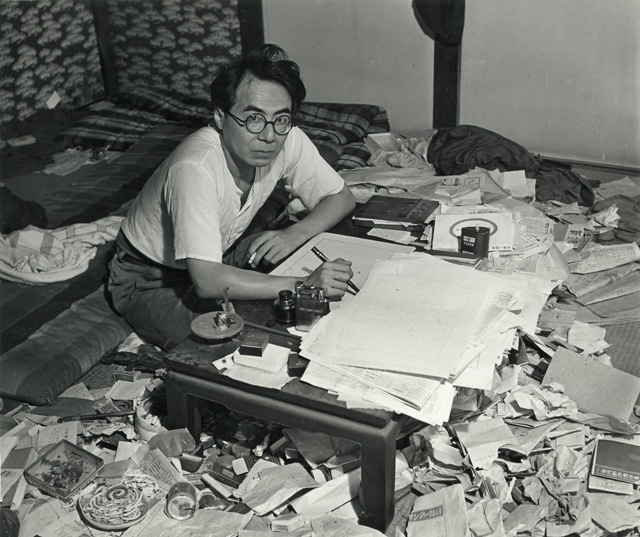
He was considered one of the most influential photographers during the time period after the war and the pictures he is famous for are the pictures taken after the war, which he have focus on the repercussions and the crisis Japan had after the fall of the empire.I have chosen these two photos because they are very uncommon during this time period in Japan. The first picture is taken 1946, and is a picture of a two orphaned kids smoking on the street.Orphaned kids on the street smoking, 1946.

The picture above is a very strong picture, with a powerful message. This was the reality for a lot of kids after the war, with their parents being killed in action the war, but also how the dramatic changes happened after the war. This picture shows the backside of the war and what poverty. It got so out of hand that the kids have started smoking. It reminds me of pictures of kids in Africa, who sniffs glue to get through their day.A writer in his study room. Taken around 1950

The final picture I have chosen is of a writer working in his study room. As you can see on the picture, it is a big mess. The picture gives me the impression of how important it was to work after the war, this man works so hard, that he doesn’t have time to clean or take a break. His food, and trash is everywhere. The subject of the photos are obviously the backside of the war. His picture were very contemporary and showed a more documentary feeling in the pictures. It is hard to see these kind of pictures in Japan today, because Japan have clearly got out of the crisis they had after the war.

Even though Japan do have poverty in small amount, that was nothing against what they had back then. These picture might now represent Japan today, but it shows that Japan have had a rough time, but they got through this hard time. It does represent the contemporary Japan during this time, but Japans image in the world is different today.

My personal opinions about the pictures is that it represents a dark chapter of Japanese history, and I have never seen similar pictures from this time. The first picture shows how the children of the war were affected, and the last picture shows how, even in the darkest times, he doesn’t give up, maybe this shows the Japanese mentality? Japanese people are famous for being very ambitious and strong for the determination. To summarize these pictures impact they had, is truly interesting. Even though it shows a dark chapter in Japan during these harsh times, it is today a memorable picture of how it used to be, and how strong Japan is today.

/Quangus

Sources for biography:

http://www.studioequis.net/showArtist.php?artistID=313

Sources for pictures:

Orphaned kids smoking on the street
http://www.helsinkitimes.fi/htimes/index.php?option=com_content&view=article&id=4636:light-and-shade-images-of-post-war-japan-&catid=21:culture&Itemid=165

A writer in his study room
http://i.yimg.jp/images/cert/digicam_text/chap1/ph_009_01.jpg

Sunday, 1 March 2009

Japanese Popular Culture

There are a lot of stuff in Japan that is very popular among the Japanese people. The one I have noticed the most is the whole 'cuteness' culture, or by some people called 'kawaii' culture. When I got here I knew very little about the big industry Japan is focusing on different things that are made for the younger generation. The first picture I've chosen this week is taken in SATY, the big mall in Hirakatashi.

I was surprised when I saw one whole store dedicated entirely on Hello Kitty. This is just one of the examples that is the kawaii culture. I find it very fascinating for how a country have built a whole industry for just the cuteness. In one of the following articles I found online - Japan smitten by love of cute. In the article the author discusses the cute phenomena. For instance, she quotes a Japanese professor that believes that cute proves the Japanese simply don't want to grow up.

I can relate to what he means. Sometimes it does feel like you are being treated like a child over here. Especially when even the warning signs are in cartoon or in manga form. Everything here is illustrated in manga drawings or with pictures of small and cute kids. The picture below is a great example of how they mixed something serious with something cute. This sign is a warning to not swim, but still the same time, it is very cute. I feel like the warning doesn't feel as important when it is illustrated like this.


So how come the kawaii culture doesn't hit big in the rest of the world? In Japan you do have a huge variety of things for the younger generation. Places like arcades, game halls, different stops where you can win teddy bears and so on. Sometimes I feel like a kid in a big toy store. This can of course make the Japanese younger generation be kids a longer time, but still it can create problems for them in the future. To see a manga kid telling you to use condoms with a big grin don't really give you the serious impression as you hoped it to be. There's nothing wrong with kawaii, but what happens when I am 40 years old, I would get tired of all cuteness, and honestly, I would feel like a pervert in a toy store, and no thank you, that I can do without.

/Quang

Sunday, 22 February 2009

Japanese People


I can't believe it's almost been a month since I got here. Even though the time flies by fast, I feel like I have experience a lot of the Japanese culture and especially with people in Japan. One thing about the people here is how everybody are so nice and polite. I myself am from an Asian family and are aware of the whole respect the elderly culture with some modifications of the Swedish culture of course. Before I got here I had some certain ideas about how polite the japanese people are, but I was still very shocked HOW polite they are. Don't get me wrong, sometimes it does feel very sincere and it does make my day just to be part of the whole culture. But hearing a bus driver saying: arigatoo gozaimasu over and over with a depressing tone does take part of the sincerity away.

The reason I used the picture above is an example of how different it is from rest of the world. The picture is taken at a concert in Namba, Osaka. The band on stage is a band called WatusiZombie. It is not the band I am focusing on, it's the audience. I am a big music fan and I've been to a lot of concert in my life, but never in Japan of course.

The part that was surprised me was how the audience acted. Usually when you are at a concert it's very crowded and when the music starts, it gets really warm and a lot of people pushing and especially to that kind of music. It was pretty hardcore rock music, and where I am from, people are pushing and doing 'moshpits'. The point is: that even when you are at a concert, this is the perfect opportunity to unleash your feelings but there were no crowding or pushing at the concert, everybody was very careful not to touch the one next to you or disturbing anyone. Shouldn't a concert of all places make you go wild?
The other picture I've chosen is a one of the first pictures of me when I got to Japan. As you can see, I am doing a peace sign pose on the picture. Also called 'Japanese pose' among international students. And I have to agree, ever since I've gotten here, I think I do this pose on every picture. What is the meaning of it? The reason I chosen this picture is to demonstrate how some things have become part of the culture so much that it lost it's meaning, or at least part of it. People do it because everybody else is doing it, not because it is something they wants to do, but something that is implied. When they don't do it, they are afraid to insult people.

So it's not about doing something nice for somebody else, it is about not insulting people. After all, the culture is working and it really feels like the most polite and safest country in the world. I wouldn't mind being part of it, even after I return to Sweden.
Arigatoo gozaimasu! Thank you for reading as what they would say in the store.
/Quang

Sunday, 15 February 2009

Neighborhood Hirakata

Konbanwa!
Since the last post I've been experience a lot in Japan, it barely feels like I have been in Japan for almost 3 weeks now. This weeks theme is my neighborhood Hirakata. Hirakata is for me very different from what I expected when I got here. I expected a big city with skyscrapers and futuristic buildings and so on. What keep bugging me since I got here, is how everybody complains how cold it is here. Where I'm from (Sweden), this is the beginning of the Swedish spring. What I like about Hirakata is how the whole town feels so small but in the reality it is the same size like the biggest cities in Sweden. I like to bike a lot here, and one thing I notice during the evenings is how everything is so quiet and dark. And this is only when I finish my afternoon class, the house are dark and I bet most of the japanese are working late.

The pictures I've chosen this week is how even though Japan is way ahead of it's time, we can still see a lot of the old japan, the traditional japan. The last picture shows how hard working japanese people are.


These two pictures are from the park right outside the seminarhouses. In the park there are a couple of stations where you can work out, and usually these places are occupied by seniors working out during evenings. No wonder Japan has the highest life-length in the world.

This store is one of the most visited by the exchangestudents. Even though the vendingmachines where you can buy beer is the most affiliated with this store, it's the woman who owns the store that fascinates me. I've been in that store a couple of times now, and it's surprising everytime I see that woman working there. She has to be at least 85 years old, and still, she is working there. How long do japanese people work? This store is open long during the evenings but is closed during the day. Even though Hirakata is bigger than most cities in Sweden, it feels way more smaller. I guess Hirakata is considered to be a small city in Japan if you compare it with rest of Japan.
/Quang


Sunday, 8 February 2009

Early Impressions of Japan


Ever since I got here I noticed how Japan like to use english in their adds and in their clothes. It is a well known fact that Japan is very fascinated of the western culture. Even though there are a lot of English words in the language, that been "Japanized" (a word that is english but been adapted to Japanese pronunciation). For an example the word beer becomes birru, or Sweden becomes Sueeden, which is very funny from my point of view (pretty much ever since I got here, I tell people I'm from Sweden, and got the same reaction every time. Shaking their heads and telling me that they don't know where it is. Then I say Suuuuueeeeeden, then everybody response with the word sugoi!). I find it interesting how a lot of japanese people wear clothes with English words without knowing what the real meaning is about. As long as the clothes have some English words that sounds catchy. English is everywhere, especially in the katakana and adds. On the picture above you can see a t-shirt my friend bought in a store.This is a funny example how there's a sentence that makes no sense what so ever. But still, there are more examples.

Here is another example where the sentence gets to confusing. The following sentence can be read under the SALE sign. For the sake of irreplacable persons, we'll dramatize a specially preserved extravagance. I have read that sentence so many times, but I can still not figure out what this sentence actually means. Still, my experience in Japan has just begun, who knows, when I am back in Sweden I will probably going to pronounce Sweden as Suuuudeeen, and bottle as botterru. More updates soon!
To be continued, or should I say, Toru beru contiinuuredu.
/Quang